Showing Up: Three Years with the Tucson Festival of Books
You don't engineer this. You just show up long enough.
The half hour before each event slot is the job in miniature.
Twenty-four escorts waiting on the south patio of Cork & Craft, venue signs in hand. Dozens of authors inside the restaurant, eating, talking, not necessarily watching the clock. A shared spreadsheet open on the table in front of us, what we call the Grid, tracking escort check-ins, venue assignments, accessibility needs, security arrangements, everything that might matter in the next thirty minutes. Three of us in red polo shirts running the whole thing: Joe, Kathy, and me.
The Tucson Festival of Books spreads across most of the University of Arizona campus. Two days, five time slots per day, twenty-four venues per slot, an average of three authors per venue. The festival is entirely volunteer-run, and Author Campus Escorts (ACE) is one of its most author-facing programs. We handle traditionally published adult genre authors. We get them from author hospitality to their panels, sit through the events, and walk them to their book signings. It sounds straightforward. The half hour before each slot is where straightforward goes to die.
Distant venues move first. Science City is on the far edge of campus, and if that escort doesn't leave with their authors early, it doesn't matter how smoothly everything else goes. So we prioritize outward and work inward, calling authors by name, circling the patio with signs, smoothly interrupting conversations mid-sentence when we have to. Kathy is our most vocal presence, direct and effective when authors need chasing down. Joe holds an improbable number of details in his head simultaneously. I tend to be the one who materializes at an author's elbow, apologizes for the interruption, and has them moving toward the door before they've quite registered what happened.
More often than not, the final minutes involve one or two of us personally walking a straggling author—or an entire panel—across campus because something fell apart at the last second. An escort didn't show. An author arrived directly at the venue without telling us. A panelist needed two more minutes inside and the rest of the group couldn't wait. Then the slot clears. The three of us find a moment to sit, look at each other, and breathe before pulling out the cards for the next round and starting again.
From Escort to Liaison
I've been volunteering with ACE for three years. The first two, I was an escort—including two years walking Suyi Davies Okungbowa between venues. He's a friend now. That's a traceable line from showing up, doing the job, and not treating the access as the point.
The escort experience is contained and personal in a way the Liaison role isn't. You have one to four authors, sustained time with them from the patio to the panel to the signing, the kind of unhurried contact that has room for actual conversation. Stepping into the Liaison role means giving that up. What you get in return is harder to name: institutional depth, a view of how the whole thing holds together, an understanding of the full scope of what ACE manages that you can't get from inside a single assignment. This year I'm one of three Liaisons, which means Joe, Kathy, and I run the program from our first Volunteer Committee meeting in November through the last signing on Sunday afternoon. The patio is the visible part. Most of the work isn't.
The event cards are one example: postcard-sized, printed front and back, with panel details, author photos, an annotated floor map, and a route to the signing—produced by a volunteer designer on a tight deadline, ready a week before the festival, and signed by authors often enough that they become keepsakes.
I should mention Salman Rushdie
Rushdie was one of our authors this weekend. Due to the security arrangements around him, he had not planned to visit Author Hospitality after his panel. Then, a few minutes before the 11:00 transition window, we were informed he'd changed his mind.
The restaurant was locked down. Armed guards took up positions. This happened to coincide exactly with the moment we needed the patio running for the 11:30 slot, which meant authors were lining up to get a moment with Rushdie while simultaneously needing to be outside meeting their escorts for their own panels.
We managed. I mention it mostly because it's the kind of thing that doesn't appear in any contingency plan, and because "armed guards" is not a sentence I expected to write in a post about literary festivals.
When the Plan Fails
It wasn't the only thing that didn't appear in any contingency plan.
During one slot on Saturday, an escort returned to the patio after walking his authors to their panel. He'd been turned away at the door by the venue monitor, told there was no seat for him despite that being a standard expectation of the role. He was angry, and reasonably so. He vented briefly and left, which meant his authors now had no escort for their post-panel signing.
All three of us were needed on the patio. The next slot was twenty minutes out. So I walked across campus to a building that was hosting multiple events, found an escort sitting through a talk in an adjacent room, and asked her if she'd be willing to pick up the other panel's authors when her event ended and walk them to their signing. She said yes without hesitation.
That's the job when the infrastructure fails. You find the next available thread and pull it.
On Knowing People
The question that sat with me longest, before I had any foothold in this industry, was also the most basic one: how do you actually meet people? Everyone says you need to know someone. Nobody explains what that looks like before you know anyone.
I still don't have a clean answer. But I can describe what it has looked like for me, and this weekend gave me several examples in quick succession.
Last year, I was assigned to escort Jonathan Maberry for his “Art of the Pitch” workshop. He had to withdraw from the festival at the last minute, which was particularly deflating timing: I was in the final stages of preparing to query literary agents, and his workshop is exactly the kind of material I would have found useful. I filed it away and moved on.
This year, while manually assigning volunteers to the same workshop, I added a lighthearted note in Diana's assignment telling her I was jealous of her slot. No particular reason. It just felt honest.
On Saturday morning, Maberry happened to walk through the ACE patio on his way into Author Hospitality. Most authors use the main entrance. He came through ours. I introduced myself, mentioned the missed connection from last year, and we talked for a few minutes. Before he headed inside, he gave me his card and told me to email him and he'd send me his workshop materials.
That was already more than I'd expected from a chance encounter. Then, after her shift, Diana came back to the patio and handed me a signed, personalized copy of his novel Red Empire. She'd gotten it signed for me because she knew I'd appreciate it. She refused repayment.
I've been thinking about what made that sequence possible. I didn't engineer any of it. I wasn't positioning myself for access. I mentioned the missed connection because it was true and because it seemed like the kind of thing worth saying. Diana paid attention to who I was and acted on it. Maberry came through the wrong entrance.
None of those things were planned. All of them were downstream of showing up consistently, doing the work without treating the access as the point, and being honest about what you care about when the opportunity to say so presents itself.
Long Threads
The Maberry sequence had roots going back a year. The next one goes back further and started somewhere less obvious. Last fall, my brother and I went to a launch party for a new installment in the Dungeon Crawler Carl series by Matt Dinniman, a Tucson author as it turns out, who graduated from a high school right next to our parents' house. The moderator for the event was a local podcaster and writer named Vickie Lan. She was good at it in the way that makes you notice: present, specific, clearly had done her homework. I connected with her on Instagram afterward.
A few weeks later, I was preparing to visit my friend Suyi in Ottawa for Can*Con and the Ottawa International Writers Festival. I mentioned to Vickie that I'd be seeing him and offered to put his name in front of her podcast if he seemed like a good fit. He did. I did. Suyi has his third novel coming out in August, so the timing was reasonable. Whether anything comes of it is up to them.
That was the extent of it. A small gesture, no expectation attached.
Fast forward to March. I saw Vickie was moderating a spec fic panel at the festival and reached out ahead of time to ask her to stop by the ACE patio before her event so we could catch up properly. She did. We talked for a while: mutual friends we discovered we had in common, her communications work for the Town of Marana, which I encounter regularly without having connected it to her until that moment, her literary agent Ali Herring, whom I've queried, her being on submission, my projects, writing craft. The conversation had the easy density of two people who already share a lot of context and are only now discovering how much.
She's going to let me know about upcoming local literary events, including things connected to Stacks Book Club, which has become one of the more significant literary presences in Tucson.
That last part matters to me more than it might sound. I used to live in San Luis Obispo, CA, a place with the kind of cohesion that makes community feel like a given rather than something you have to assemble. Tucson is a different kind of city. It has some sub-communities with strong internal identities, but a unified local culture has been an absence I've felt since moving here. The industry connections I've built over the past few years are real and I value them, but they're diffuse, distributed across cities and conferences and online spaces. The possibility of something more rooted and local is newer, and it's something I find myself paying attention to.
The Vickie thread started at a book launch I went to because my brother wanted to go. It moved through a small act of generosity toward a friend who didn't need anything from me. It arrived, months later, at a conversation on a festival patio that opened something I hadn't expected.
A Particular Resonance
I should say something about Alix E. Harrow, because her presence at the festival this weekend carried a particular kind of resonance for me.
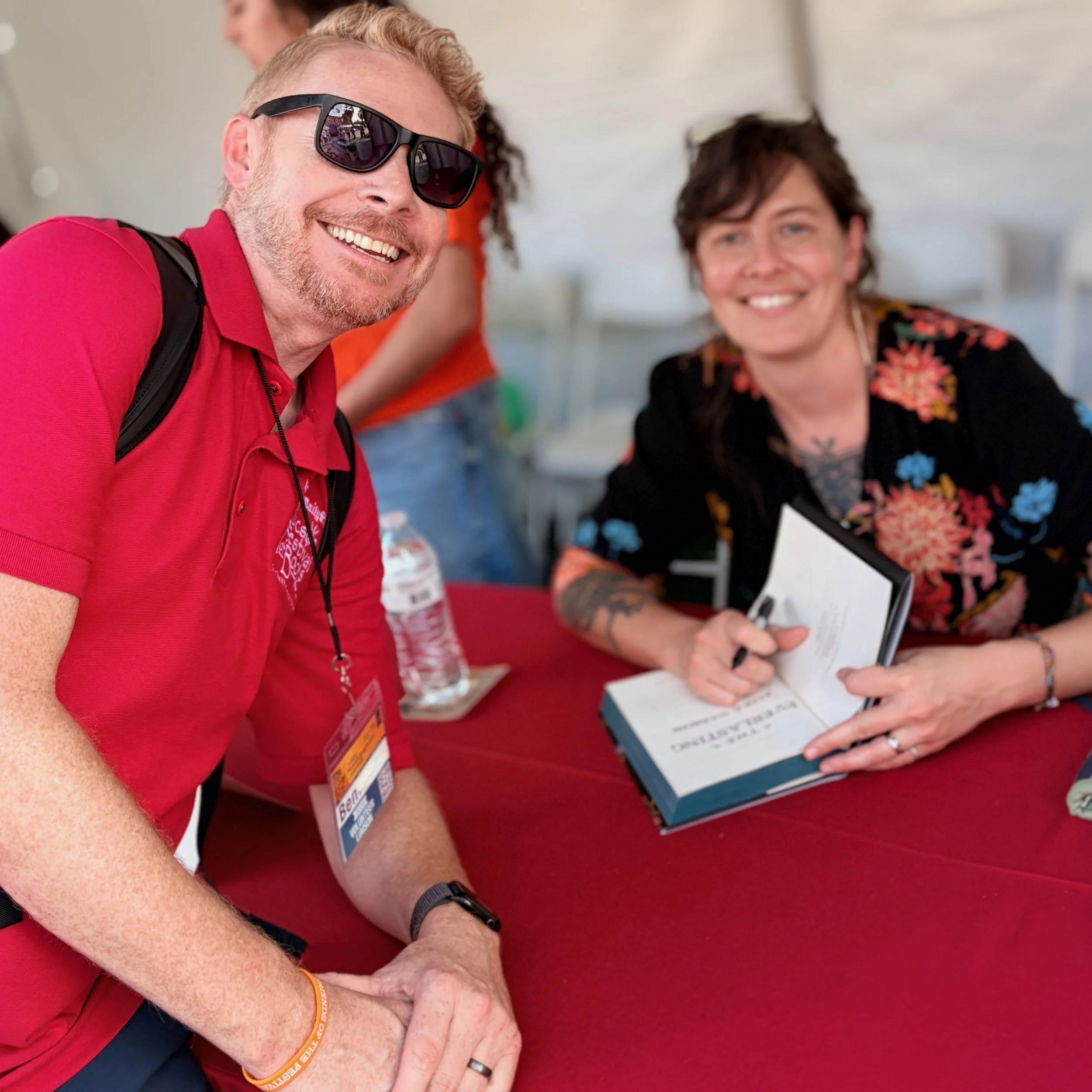
Harrow's The Ten Thousand Doors of January is one of the two novels I cite as comps for my novel, The Fractured Soul. I've been living with that book as a reference point for long enough that it has become part of how I understand my own work. Meeting her, talking with her over the course of the weekend, getting my copy of her book signed at the end of it: none of that was something I'd planned for or expected to feel as significant as it did.
At one point she told me about her experience at the festival. She'd been picked up from the airport by a volunteer, put up in a hotel, driven to the venue, taken to Author Hospitality, and walked between events consistently all weekend. She said it was a pleasure. I'm glad she said it, and I'm glad I was in a position to hear it, because it named something I'd been watching all weekend without quite articulating.
What authors experience at a well-run festival is the absence of friction. Most of them have no reason to wonder what produces it. That's how it's supposed to work. That's literary citizenship from the inside.
An Honest Aside
Not everything from the weekend sits as cleanly as the Maberry sequence or the conversation with Vickie.
On Sunday, an escort didn't show for the final slot. I stepped in to walk three authors to their panel, unplanned, without having had time to review who was who. One of the authors was deaf. I didn't know that going in, and in the initial introductions I directed my attention to her ASL interpreter rather than to her.
I sat through the panel and figured it out. Afterward, as I was walking the group to their signing, I made a point of apologizing to her directly and addressing her as I should have from the start.
She was gracious about it. She's probably had to be gracious about it many times before.
I'm glad I caught it. I'm less comfortable with how unremarkable my mistake likely was to her, and what that says about how often it happens. There's no clean resolution to that. I just wanted to name it.
Literary Citizenship
One thing I heard repeatedly this weekend, from authors, from moderators, from attendees, from volunteers in other programs: the Tucson Festival of Books is one of the best-run festivals they've been to. Authors in particular kept saying it. The hospitality, the organization, the sense that someone had thought carefully about what they needed before they knew they needed it.
The festival is entirely volunteer-run. There is no professional event management company behind it, only a few paid positions coordinating the moving parts. What produces the experience authors describe is a few thousand people who show up every year, learn their roles, care about getting it right, and do it without compensation beyond the work itself.
I've been one of those people for three years. This year I got to see more of the full picture than I had before, and what I saw was a community that takes the work seriously because the work is worth taking seriously, not because anyone is keeping score.
I started volunteering with ACE because I wanted to be useful to something I cared about. I didn't have a strategy. I wasn't building toward anything in particular. I showed up, learned the campus, walked authors between venues, and tried to make the experience as frictionless as possible for the people I was serving.
Three years later, I have friendships that started on that patio. I have a signed novel personalized to me by an author I've admired for years, obtained by a volunteer who was paying attention to who I am. Ursula Vernon (T. Kingfisher) bought me lunch! And no, I'll never not geek out about that. I have a conversation with a local writer that opened a door into a community I've wanted to find since moving to Tucson. I have workshop materials coming from one of the most respected voices in genre fiction, because I mentioned an honest thing at an honest moment.
None of that was the point. All of it arrived anyway.
I think about the writers I know who are earlier in this process, still wondering how any of it works, still looking at the industry as a closed system with no visible entry points. I was there not long ago. I don't have a formula to offer. What I have is this: find something worth serving. Serve it without keeping score. Stay long enough for the work to know your name.
The rest has a way of finding you.
PS: check out the authors I’ve mentioned!
Alix E. Harrow: https://alixeharrow.wixsite.com/author
Vickie Lan: https://vickielan.com
Jonathan Maberry: https://www.jonathanmaberry.com/
Suyi Davies Okungbowa: https://suyidavies.com/
Salman Rushdie: http://salmanrushdie.com/
Ursula Vernon/T. Kingfisher: https://redwombatstudio.com/